



-
It may take blocking the oven entrance to get that heat down to the floor and letting the oven temps balance. At the end of a firing, find something (noncombustible) to close it off. I've seen some stack enough brick up in front of the entrance to completely block it off. (I'm assuming that you haven't built a door yet) An hour later you may find the temps a lot closer together. During a firing, you can drag some coals across the entrance to make sort of a short levee. That will make the air entering the oven take a little higher route than directly across the floor.Last edited by Gulf; 09-01-2015, 12:00 PM. -
No not yet. I feel it would be little difficult since the temps on the floor are still nowhere near those up in the dome. After work today, I started a new fire perhaps coming back to 175C seeing if the oven will perhaps even put more as water is being driven out. I'll try to continue (moderately) slow.Leave a comment:
-
That sounds wonderful to someone who lives as far south as I do. If you can ever catch all of that in a photo, it would be epic! I'm glad to hear that you are enjoying your oven . There has been a lot of heat in there,...............,have you cooked something?
Leave a comment:
-
Have started curing the oven this weekend. First with briquettes for two days and later with wood, coming up to 150C yesterday and 175C today. I find it difficult to know where to measure the temp since the floor is way cooler than up in the dome. I decided to put the thermometer on some bricks high up just inside the entry arch in the flow of hot air. Thought this would at least not lead to mistakingly high temps. Firing the oven is greatly satisfying. We are gathering around watching (yesterday with some aurora borealis and the full moon above). Quite a scene : )Leave a comment:
-
Thanks, I'll go for one of those and cure the oven in a couple of weeks when it has dried up more.Leave a comment:
-
The dome looks great! A manual oven thermometer can usually be found real easy and cheap over here. They are just fine for the temps in the first heatings. And, you can use it later on for cooking. I would give it at least one more week, just for the vermicrete. You have insulation protecting it everywhere but right against the chimney. My advise is to start slow and gentle with charcoal (briquette or lump). No direct flames. You can cook something while your at it.
Leave a comment:
-
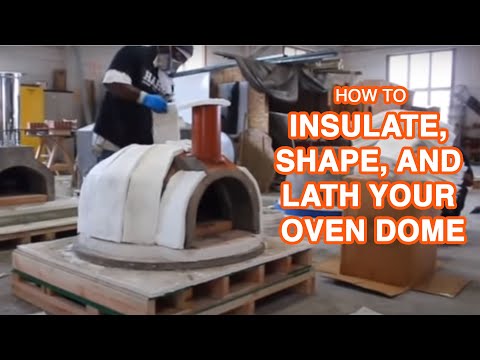
Yesterday, I finished the insulation layer with the last vermicrete on the top. I decided to go with Rockwool as the bottom layer directly on the dome. Then tied it down using wire and the mesh attached already to the blankets. Only one 30 mm layer, but I didn't want to throw what was left on the roll so I put two layers on some of the dome. Then covered it with vermicrete starting from the bottom up and using a rotating template as suggested. I think the resulting shape turned out pretty round. Now my plan is to let the vermiculite dry out before adding any stucco sealing the surface. At least a month. Sounds like a good plan? The stucco I will use is normal stucco without any water proofing additives, so it won't be water proof. Perhaps that is necessary.
I am of course excited about starting using the oven. Can I can I can I? I will read up on curing before doing anything. Read the building plans but found it a little bit difficult since I don't have any laser temperature reader. Perhaps there are other schedules that work as well. The oven dome has been completed now for two weeks but the insulation just yesterday. So should I wait 1-2 weeks before starting curing the oven counting from now or from when the dome was completed?Leave a comment:
-
The ovens that I used Rockpool insulation on had it directly over the dome, then a layer of vermicrete over the Rockpool. They work fine although I've not pulled them apart to inspect the Rockpool. The vermicrete was a little more difficult to apply over the Rockpool compared to ceramic blanket. It was more difficult when asking the vermicrete to stick and stand up against the Rockpool. I had to come back and patch a few areas the next day from memory.Leave a comment:
-
Which would make me think rockwool should be fine directly on dome. Adding vermicrete below and outside the rockwool would add to more work.Leave a comment:
-
you won't get anywhere near 600 C on the outside of the bricks. 500 at tops.Leave a comment:
-
Thanks for all input!
But really, what temperature should I expect at the outside of the dome bricks? If Rockwool is specified to withstand 1000 C (1800 F) before melting, should that not be enough? I would have guessed the dome outside to be perhaps maximum 600 C, but I have of course no real idea.Leave a comment:
-
No worries, old friend.Originally posted by cobblerdave View Post
In my first reply I acknowledged that I had no experience with mineral wool in this type of application. I had hoped that folks with first hand experience with it would weigh in. I knew that it wasn't sufficient for a kiln. Even though, many think that it is an alternative for the temps of a WFO. However, I am real curious why 2" of ceramic fiber blanket wont stop "true" mineral wool form melting but, 3" of vermiculite will?
just askin'
Leave a comment:
-
G'day
I used rockwool as a Secondary insulation. 4 ins of rockwool OVER 2 ins of ceramic blanket.
Wire mesh over that and rendered over the wire.
I checked a no of years later and posted the results but cant find that thread now. Yes I cut a hole in the dome render.
My recommends would be a 3 in layer of V-crete to take the high heat then the rockwool. (Sorry Gulf)
As for the aluminium. All ovens other than those under full cover get damp from time to time. Its never a real problem you just need to fire the oven a few times. Aluminium out of the open air in contact with moisture will corrode. Just get a piece of cooking foil and put it under brick and leave in the yard on the ground. It will start to corrode before the weeks out.
Regards dave
Leave a comment:
-
The woven fabric on the RockWool Vent felt like it would easily let moist through. I believe there is also an aluminum-foil version of this blanket, that perhaps is not as suitable then. One issue I found was a little tricky was how to keep the blanket tightly fit round the dome. I made some cuts in the square blanket to make it better fit the round dome, by overlappning the cuts. Are there any clever tricks here to get the blanket into good shaping prior to vermicrete? I've seen some people put wire mesh on the blanket, but not shure how to secure that to shape. Perhaps just get it into acceptable shape and then when vermicrete is put on, it helps weigh it down and secure it?
The Rockwool blanket was good priced at around 50$. I would say that perhaps even cheaper than for me to use the vermiculite, and another reason to go for 2-3 passes of RockWool blanket. If I can just return some of the 400 liters of vermiculite : )Leave a comment:


Leave a comment: