




Announcement

Collapse
No announcement yet.

3:1:1:1

Collapse
X
 
  • Filter
  • Time
  • Show
Clear All
new posts

  • Tscarborough
    replied
    Re: 3:1:1:1

    I realize that it would take some serious Google-Fu to find a free C-270 specification so let me summarize it for you.

    ASTM C-270 allows for 2 methods by which to specify a mortar:

    Proportion specification
    or
    Properties specification

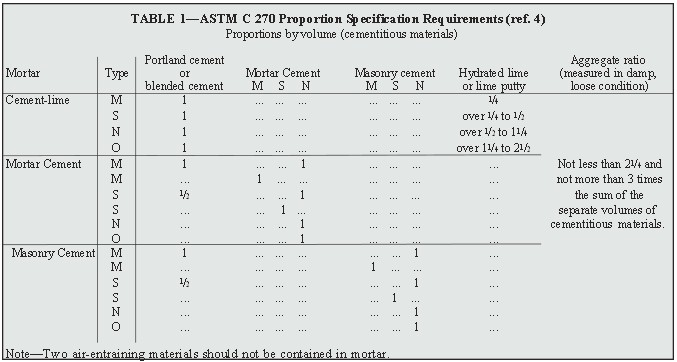
    Proportion specification is the one we are using, it denotes a mortar type by the volumeteric amounts of each ingredient. Mortar types are designated M,S,N,O, respectively in order of design strength, although the proportion specification does not call out or require a specific strength for each and there is no allowance given for either field or laboratory testing. This is the most common for all but government work. See chart below:


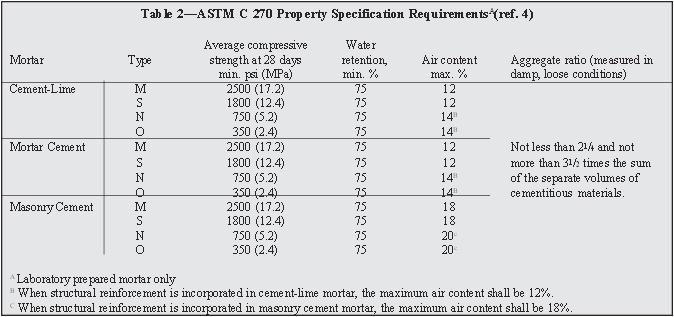
    Properties specification is used when the physical properties of a mortar are thought to be critical, i.e. when free money is involved, AKA known as the Government. It requires that the actual physical materials to be used be tested in a laboratory under given conditions (ASTM C-780, Standard Test Method for Preconstruction and Construction Evaluation of Mortars for Plain and Reinforced Unit Masonry). This is expensive and is often abused and misunderstood to think that you can grab mortar off a mason's mortarboard and test it. Not allowed. This is the properties chart showing required strengths:


    I doubt any of that will mean much, but at least it gives you an idea of what is involved.

    Leave a comment:


  • Tscarborough
    replied
    Re: 3:1:1:1

    C-270 deals with mortar, it doesn't matter if it is for Antarctica or for your oven, the physical properties required for unitary masonry apply. That said, it does not apply to Calcium Aluminate mortar which is what refractory cement is. The points I am making as referenced by C-270, however, do apply to refractory mortar, i.e. the desired strength and workability.

    Refractory mortar physical properties are defined in C-199, which would not allow you to use homebrew at all.

    Leave a comment:


  • brickie in oz
    replied
    Re: 3:1:1:1

    I cant believe how many ppl have got their knickers in a knot just because TS made the suggestion that the home brew mortar is way too strong?

    Leave a comment:


  • brickie in oz
    replied
    Re: 3:1:1:1

    Originally posted by Laurentius View Post
    Don't know about that, but sick ---ks, use to kill people's pet by placing it about for them to lap up.
    1985 diethylene glycol wine scandal - Wikipedia, the free encyclopedia

    Leave a comment:


  • Laurentius
    replied
    Re: 3:1:1:1

    Originally posted by brickie in oz View Post
    Didnt they used to put it in wine in Europe some time ago?
    Don't know about that, but sick ---ks, use to kill people's pet by placing it about for them to lap up.

    Leave a comment:


  • brickie in oz
    replied
    Re: 3:1:1:1

    Didnt they used to put it in wine in Europe some time ago?

    Leave a comment:


  • Laurentius
    replied
    Re: 3:1:1:1

    Originally posted by Tscarborough View Post
    No, I am telling you that if you applied whiskey principles to anti-freeze you would be dead.
    Yes, you are! If the first bottle he ever drank had been anti-freeze, he would have never spent a penny on whiskey.

    Leave a comment:


  • Tscarborough
    replied
    Re: 3:1:1:1

    No, I am telling you that if you applied whiskey principles to anti-freeze you would be dead.

    Leave a comment:


  • Les
    replied
    Re: 3:1:1:1

    Originally posted by Tscarborough View Post
    anti-freeze (contains alcohol) and whiskey (contains alcohol) are the same.
    Are you telling me I have been buying whiskey all these years when I could have saved money buying anti-freeze?

    Leave a comment:


  • Tscarborough
    replied
    Re: 3:1:1:1

    The reality is that there are very few engineers trained in unitary masonry. They study concrete, and concrete (contains cement) and unitary masonry (contains cement) are not the same thing any more than anti-freeze (contains alcohol) and whiskey (contains alcohol) are the same.

    The rule for mortar is to always use the absolute weakest mortar that will suffice, and this is antithetical to a concrete engineer. Mortar should ALWAYS have less compressive strength than the units it is binding together. Mortar is not harmed by excess water or retempering, both of which are opposite to concrete.

    Using a 3:1:1:1 will work, but the question remains: Is that the proper or best mix? The answer is no. Just as the shape and dimensions of a Pompeii oven have evolved and been fine tuned over the centuries, so has the art of making mortar. It is only in the last 100 years that the art of mortar has been confused with the science of concrete and therein lies the confusion.

    Mortar specifications are broad for a reason, and that reason is that the mortar must be prepared for the conditions, not to a narrow definition such as compressive strength.

    If you doubt that this is so, study ASTM C-270 which is the ruling specification for mortar.

    Leave a comment:


  • Les
    replied
    Re: 3:1:1:1

    Originally posted by brickie in oz View Post

    Id be happy to dry stack the bricks and then slurry around the outside to keep it all together.
    That's exactly what I did - and it works!

    Leave a comment:


  • stonecutter
    replied
    Re: 3:1:1:1

    Originally posted by brickie in oz View Post

    Id be happy to dry stack the bricks and then slurry around the outside to keep it all together.
    That's the way many neapolitan domes are professionally built.

    Leave a comment:


  • brickie in oz
    replied
    Re: 3:1:1:1

    I actually dont like to see mortar joints inside an oven its the point of failure.
    Some builds on here must think they are building a house the joints are that big.

    Id be happy to dry stack the bricks and then slurry around the outside to keep it all together.

    I used pre made thin joint refractory bog on my build and you need a feeler gauge to measure the joints.

    Leave a comment:


  • shuboyje
    replied
    Re: 3:1:1:1

    Lime is considered cementitious, and arguably the fire clay, since it doesn't get fired hot enough, is not. So at this point we might argue the ratio of sand+clay to cement + lime is 2:1 in the homebrew. A very rich mix indeed if you are building a house. If anything moves the bricks might break before the mortar gives.
    This is exactly what I found when I demolished my first oven to build a bigger one. When I tried to chip the mortar off the bricks broke before the mortar gave. I finally resorted to cutting the mortar off the bricks I planned to reuse.

    Leave a comment:


  • Tscarborough
    replied
    Re: 3:1:1:1

    May as well get it right and not confuse the issue. Use 6:1:1:1 and you will be a lot closer to a good starting point than 3:1:1:1.

    Leave a comment:

Working...
X