
Re: temporary dry-stacked WFO - square design
Gudday
That flue is sounding like it will be placed inside the oven. If that's the case you will be back to square one with the heat retention. Instead of the heat going out the door it will be going up the flu and the only thing you'll save is your eyebrows. These ovens have the flu outside the door for a reason, let your oven breath naturally like it wants to.
On your hearth insulation it doesn't cover the whole of your structure. In further mods it might pay you with your heat retention to extend this.
Regards dave





-
Re: temporary dry-stacked WFO - square design
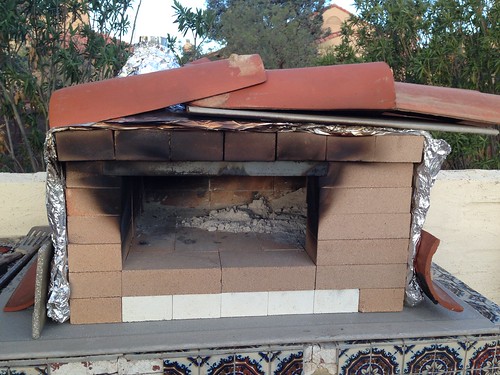
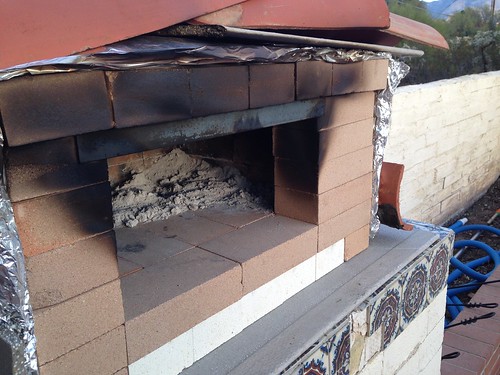
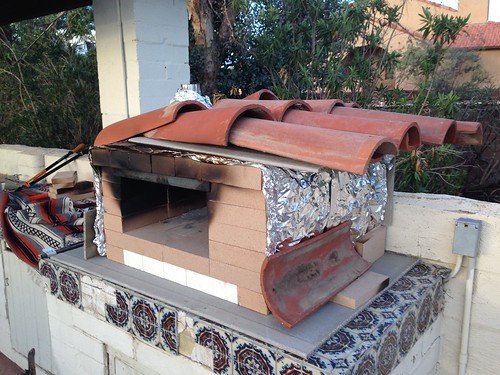
here are some updated photos of the current configuration
cooking floor is effectively 18" deep by 23" wide, plus a little bit in front. But there is basically no entryway as I ran out of depth in my available space.
Ceiling is 10.5" high. The 2" angle iron forms the only pseudo-entryway/arch. It definitely smokes a bit when the fire is getting going (as you can see from the charred brick faces), but once the logs are actively burning, it actually cleared quite a bit. I think I will lower the angle iron one course which will give me 7.5" entry height. 0.71 ratio instead of the perfect 0.63 ratio, but we ain't going for perfection here!
The flue is a piece of HVAC duct, 9"x4" opening transitioning to 3" diameter outlet. Haven't done the math but seems like less than 0.15 of entry area. Considering rearranging so the flue in directly behind the entryway, rather than of to the left side.
 Last edited by TylerDavis; 11-13-2013, 08:54 AM.
Leave a comment:
-
Re: temporary dry-stacked WFO - square design
GuddayOriginally posted by stonecutter View Post
Stone cutter ,Good point!
I'm looking at his reason for TylerDavis needing having a door during firing anyway.
TylerDavis...The entrance height is the same as the roof height, any heat escape long before it can be stored in the brick. The entrance height to oven interior roof height should be in a perfect world 63 per cent . And this in not just a forno thing its been around since these "black ovens" were built thousands of years ago. On the point of the ceiling of your oven as well, it might pay to put some thicker brick on top. Heat goes up and this is were you need some mass to store that heat in.TylerDavis you ovens dry stacked so you might want to use some angle iron for example to lower your entrance height down some.
You'll find then the oven will "breath" efficiently. The flue gas will be burnt on the ceiling of you oven and you will have little visible smoke. As the flue gases escape the lowered entrance fresh air will be drawn in low to make the fire burn. The fire being contained in space were the heat is reflected back on the fire , the wood will be burn more efficiently than an open fire.Last edited by cobblerdave; 11-12-2013, 03:33 PM.Leave a comment:
-
Re: temporary dry-stacked WFO - square design
Ahhh, but why not make insulated door anyway....it will do the job of two types of doors, rather than a single purpose blast door. Having two doors doesn't seem practical, but that's just my opinion.Originally posted by cobblerdave View PostLeave a comment:
-
Re: temporary dry-stacked WFO - square design
GuddayOriginally posted by TylerDavis View Post
You don't need an insulated door. An insulated door is to retain heat after the flames, not during firing. What you need is a blast door. It a simple door of metal , it doesn't require insulation as it reflects heat back into the oven. It doesn't need to be insulated and seal the oven mouth as it must be able to let smoke out and air in.
Regards daveLeave a comment:
-
Re: temporary dry-stacked WFO - square design
Percrete is friable (crumbly) on it's own. Consider building SS or Aluminum form and fill that with your insulation mixture. Less portland will have a greater r value, and if your p-crete is filling a metal panel, then something like 10:1 will work well.Originally posted by TylerDavis View PostLeave a comment:
-
Re: temporary dry-stacked WFO - square design
well I'd like to have the door in place during heat-up, which would be over 300 C. I plan to leave a hole and damper through the door to adjust airflow. Do I need to use refractory cement instead of Portland cement to make my perlcrete?Leave a comment:
-
Re: temporary dry-stacked WFO - square design
Gudday
Good to hear you enjoying yourself with that oven.
Recon you could easily cast a pearlite cement door , and 6 to one sounds plenty strong. I expect it would be a lot like hebel , even though it has Portland cement in the mix you don't really need to place it on over 300C which is the point where Portland breaks down. Your main worry is dropping it it can shatter.
You really got dome cool pieces to play with firebrick insulated firebrick ceramic insulation. Recon if you should be done playing now and get serious on an oven.
Check out Budget build 36' in this section. I note the simplicity of the build no fancy cutting and the time line it was a really fast build.
Thanks for posting your results I'm alway interested in something different
Regards DaveLeave a comment:
-
Re: temporary dry-stacked WFO - square design
since I took these pictures, I have reconfigured the doorway slightly, and added ceramic blanket on the outside of the firebrick


Leave a comment:
-
Re: temporary dry-stacked WFO - square design
I've got my oven put together and fired it last night to cook some chicken thighs and root vegetables. Turned out fine; learned a lot in the process. The weak point right now is the door. I cobbled together a rectangular plywood back with fiberglass insulation shielded by aluminum sheet metal. It works OK for shielding the heat but doesn't fit tightly.
Can I build a perlite-concrete slab door to replace it? Is the perlcrete too crumbly for this purpose? I'm thinking of using the plywood as a form, then casting perlcrete two inches thick. Will the perlcrete withstand the direct fire temperature, or do I need to protect the inner face with something? 6:1 ratio of perlite:concrete? Then just enough water to hydrate it?Leave a comment:
-
Re: temporary dry-stacked WFO - square design
the aerated concrete looks intriguing; couldn't find any distributors in Arizona. Anyone in the states have a lead for me?Leave a comment:
-
Re: temporary dry-stacked WFO - square design
Gudday
The prospect of bits of insulation of any type out in the open especially around food is not that appealing. Your better to seal it in.
If you can get hold of some airated cement block ( 1/4 the weight of cement) you can carve yourself a door to fit . Silastic the ply on the front and add a couple of handles. Links at the bottom for my door
Regards dave
Ps that link has Also has a pic of the worst most dog ugly door ever used.
Two pieces of ply covered with aluminium foil. Worked ....just. Survived more than three times. Couldn't stand it, so I made him one of airated concrete.Last edited by cobblerdave; 10-21-2013, 02:44 AM.Leave a comment:
-
Re: temporary dry-stacked WFO - square design
got my bricks and dry-stacked them this weekend
fired a test-fire and realize I need some form of a door to retain heat. Can I screw a sheet of Kaowool blanket to the inside of a piece of plywood and use that as a door?
I had bought 1/4" 2300* felt blanket a few years ago but now I can only find 1/2" and it's gotten more expensiveLeave a comment:
-
Re: temporary dry-stacked WFO - square design
Gudday TylerdavisOriginally posted by TylerDavis View Post
Picked up your mention of propane flame. Sorry but its been policy on the forum for a number of years that discourages discussions on gas fired homebuilts.
Just common sense really , its just to dangerous. Leave the "gas fits"to the pros
Regards daveLeave a comment:
-
Re: temporary dry-stacked WFO - square design
thanks for the leadOriginally posted by cobblerdave View Post
here's the link for myself and others:
Sounds like TMan had quite a bit of success with his "temporary" oven. $50 and 4 hours invested. Little residual heat, but cranks out 88 pizzas in one session - hard to argue with that.Leave a comment:


Leave a comment: